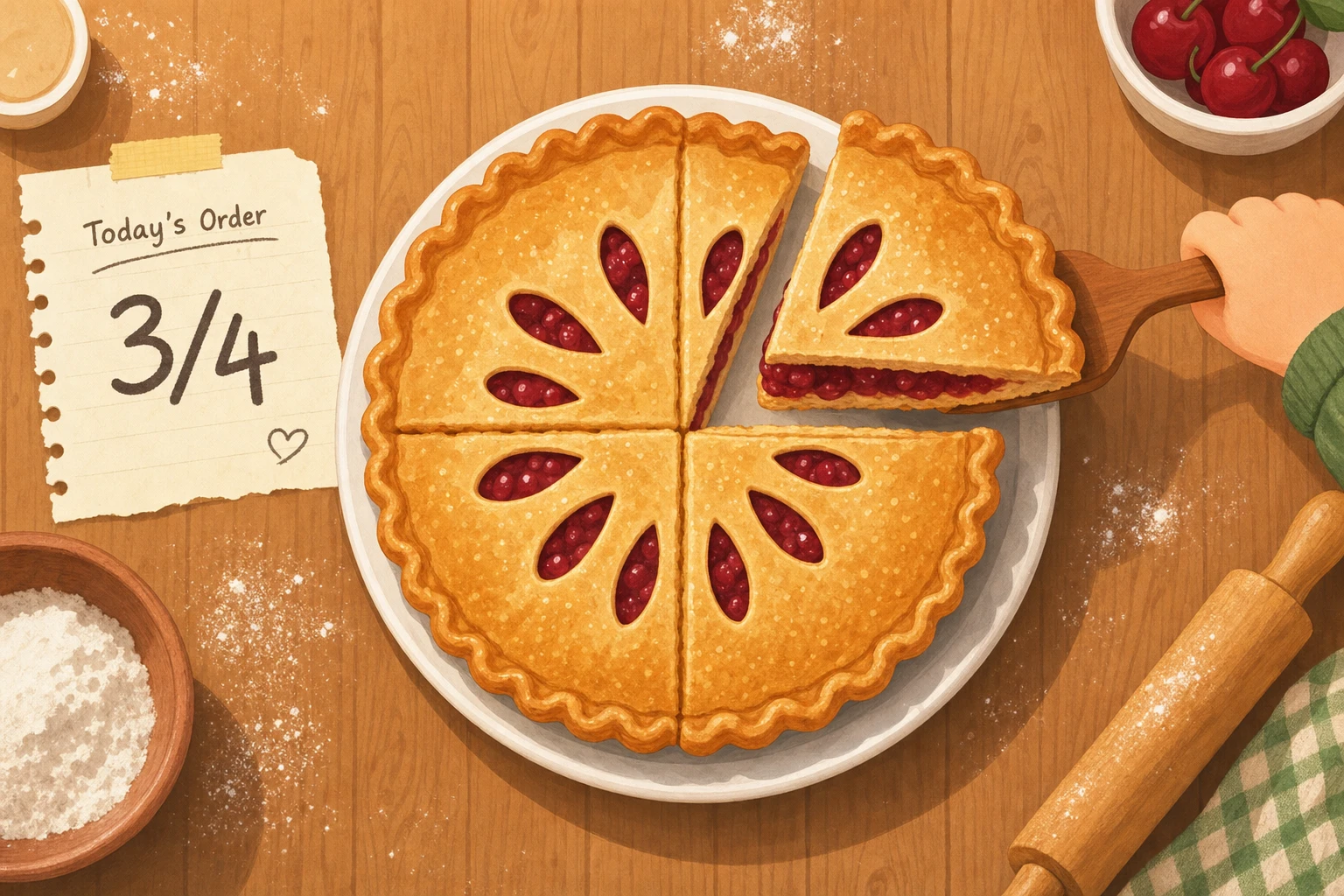
Fraction Kitchen
Fractions describe covered equal parts of one whole; equivalent fractions cover the same space, and equal-sized wholes make unlike fractions directly comparable.
What your child will figure out
- Build proper fractions across halves through fifteenths and explain the numerator and denominator as covered parts and total equal parts.
- Build and predict equivalent fractions created by re-slicing an unchanged amount by factors of two and three.
- Compose target fractions from compatible mixed unit fractions instead of relying on one repeated piece size.
- Compare and identify equality among unlike fractions, including close pairs, then transfer all four relationships into adaptive practice across varied contexts and denominators up to 24.
The levels
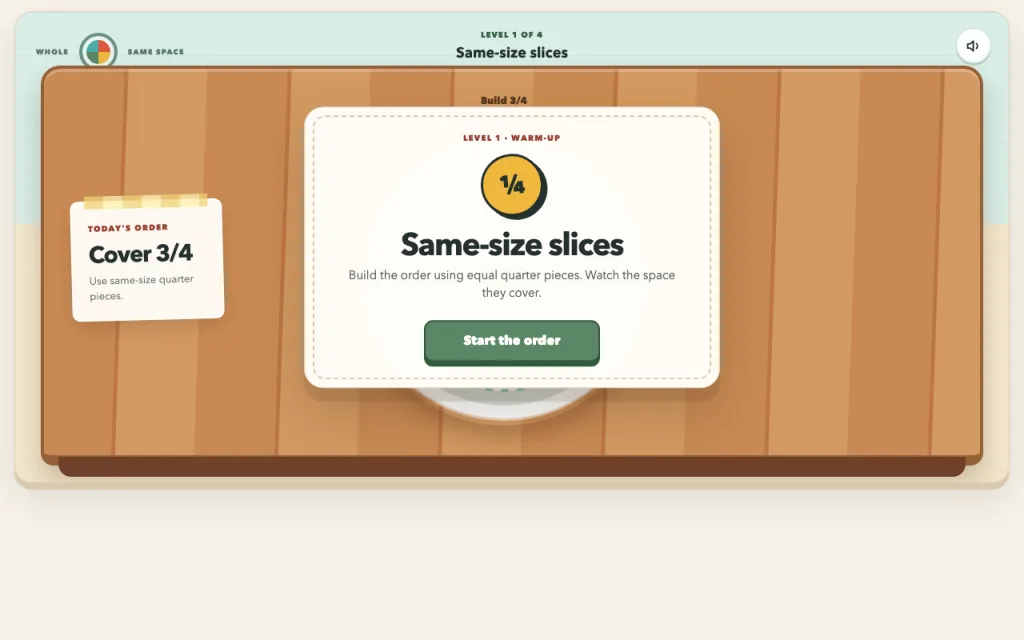
- Same-size slices
Build 3/4 from quarters and explain both numbers as covered and total equal parts.
- Two ways, one amount
Build 1/2 and 2/4 on matched plates and explain repeatable equivalence.
- Predict the eighths
Predict and test the numerator in 3/4 = ?/8.
- The chef’s challenge
Build and compare 2/3 and 5/6 using equal-sized plates.
- Fifths for lunch
Transfer part-whole building to the unfamiliar target 2/5.
- Thirds become sixths
Build 2/3 and 4/6 as two repeatable names for one amount.
- Tenths prediction
Predict and test the numerator in 3/5 = ?/10.
- A close dinner call
Distinguish the close pair 3/4 and 5/8 by covered and uncovered area.
- Triple-cut catering
Scale 2/5 into fifteenths by a factor of three and verify the prediction.
- Different cuts, exact tie
Recognise and justify that 4/6 and 6/9 are equal.
- Mixed-piece platter
Compose 7/12 from a choice of compatible thirds, quarters, sixths, and twelfths.
- Banquet transfer
Compare the unfamiliar close pair 7/10 and 5/8 without digit shortcuts.
Ready when they are.
Play Fraction Kitchen free — no account, no card.
Play Fraction Kitchen free