The best binary numbers games in 2026
Binary is a perfect ten-minute revelation: five lightbulbs, each worth double the last, and suddenly your child can write any number to 31 in on-off switches. These are the binary games that deliver that moment in 2026.
Binary is not hard because it uses only zero and one; it is hard because children must separate a digit from the value of its position. They may read 101 as one hundred one, or treat each lit bit as worth one. The developmental click comes once ordinary place value is solid and they notice that each position doubles instead of multiplying by ten. For many children around ages 9 to 12, building numbers with switches makes carrying and place value newly visible.
A good binary game should let a child construct a target, inspect the value of every bit, and see what happens when a bit flips. Look for doubling patterns, prediction before conversion, and carries that visibly ripple across positions. Timed translation drills are useful only after the structure makes sense. A bad game teaches a lookup routine or rewards frantic clicking; a strong one lets children test several representations and explain why 01111 becomes 10000 when one is added.
A ten-minute session is plenty because binary reasoning is concentrated work. Ask, “Which switch gives us the biggest useful value?” and “Can you make the same total another way?” The second question should lead to the discovery that a binary representation is fixed for a given set of places. At the kitchen table, label five cards 1, 2, 4, 8, and 16. Turn cards faceup to build someone’s age, then find the largest number the cards can show.
Top picks for 2026
1. Binary Lights
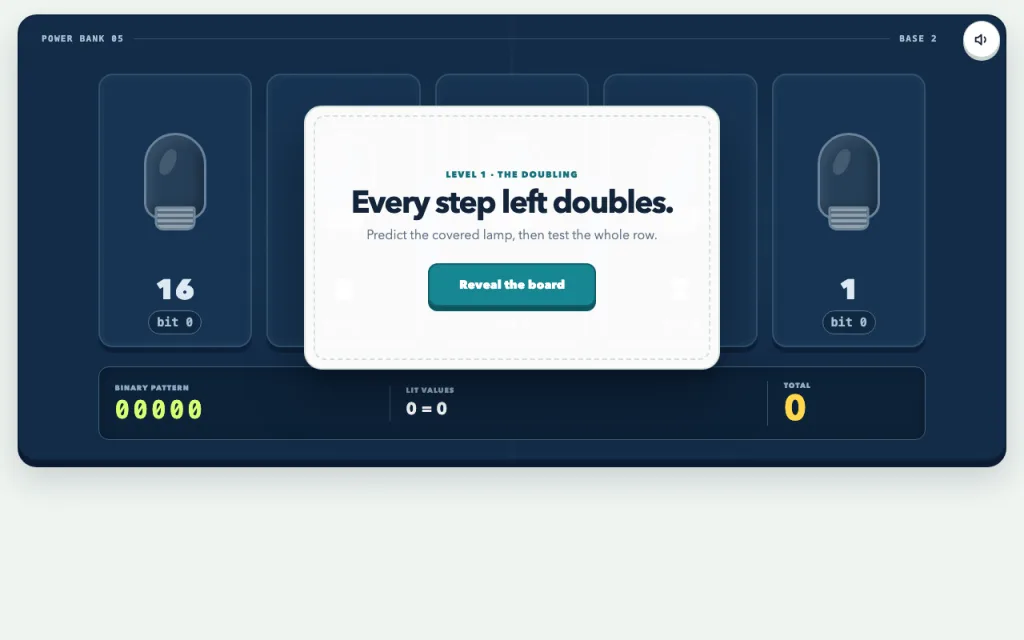
Binary Lights hands your child a row of glowing bulbs — 16, 8, 4, 2, 1 — and asks them to build numbers by flipping switches. The doubling pattern, the carry ripple, the five-bit maximum: each becomes a discovery, not a lecture. Ako, the voice AI tutor, nudges with questions instead of answers. Ages 10–13, first lesson free.
Common questions
Why teach kids binary?
It's the smallest complete example of how computers actually work — and it doubles as place-value practice in disguise. A child who gets binary understands base-10 more deeply too.
What age can kids learn binary?
The on/off switch idea lands from about age 8; converting numbers comfortably usually clicks around 10–13.
Is Binary Lights free?
First lesson free in the browser, no account. A subscription unlocks all 100+ Ako lessons.